
971 lines
23 KiB
Markdown
971 lines
23 KiB
Markdown
# Laravel Telescope
|
||
|
||
* Introduction
|
||
* Installation
|
||
* Local Only Installation
|
||
* Configuration
|
||
* Data Pruning
|
||
* Dashboard Authorization
|
||
* Upgrading Telescope
|
||
* Filtering
|
||
* Entries
|
||
* Batches
|
||
* Tagging
|
||
* Available Watchers
|
||
* Batch Watcher
|
||
* Cache Watcher
|
||
* Command Watcher
|
||
* Dump Watcher
|
||
* Event Watcher
|
||
* Exception Watcher
|
||
* Gate Watcher
|
||
* HTTP Client Watcher
|
||
* Job Watcher
|
||
* Log Watcher
|
||
* Mail Watcher
|
||
* Model Watcher
|
||
* Notification Watcher
|
||
* Query Watcher
|
||
* Redis Watcher
|
||
* Request Watcher
|
||
* Schedule Watcher
|
||
* View Watcher
|
||
* Displaying User Avatars
|
||
|
||
## Introduction
|
||
|
||
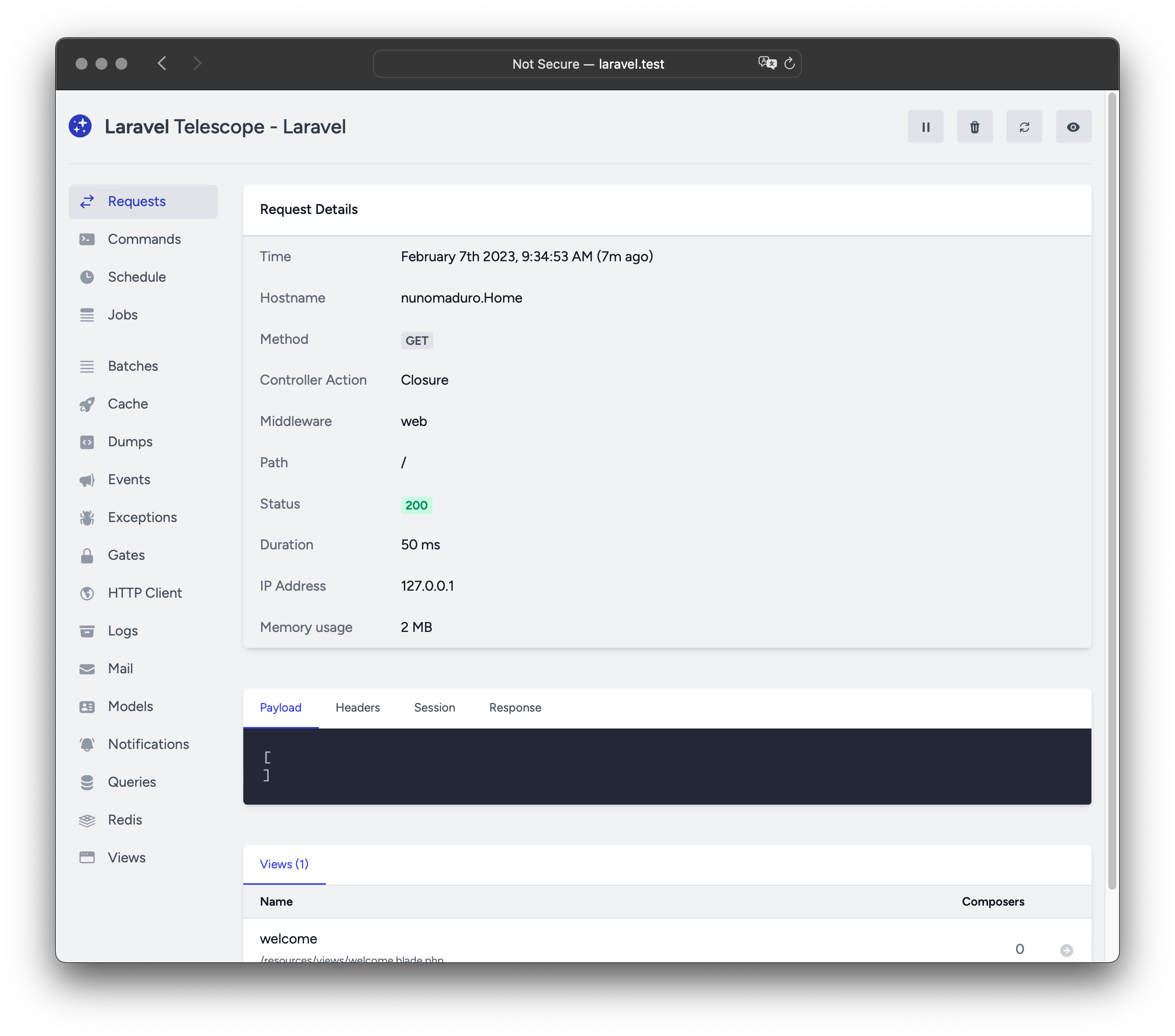
[Laravel Telescope](https://github.com/laravel/telescope) makes a wonderful
|
||
companion to your local Laravel development environment. Telescope provides
|
||
insight into the requests coming into your application, exceptions, log
|
||
entries, database queries, queued jobs, mail, notifications, cache operations,
|
||
scheduled tasks, variable dumps, and more.
|
||
|
||
|
||
|
||
## Installation
|
||
|
||
You may use the Composer package manager to install Telescope into your
|
||
Laravel project:
|
||
|
||
|
||
|
||
1composer require laravel/telescope
|
||
|
||
|
||
composer require laravel/telescope
|
||
|
||
After installing Telescope, publish its assets and migrations using the
|
||
`telescope:install` Artisan command. After installing Telescope, you should
|
||
also run the `migrate` command in order to create the tables needed to store
|
||
Telescope's data:
|
||
|
||
|
||
|
||
1php artisan telescope:install
|
||
|
||
2
|
||
|
||
3php artisan migrate
|
||
|
||
|
||
php artisan telescope:install
|
||
|
||
php artisan migrate
|
||
|
||
Finally, you may access the Telescope dashboard via the `/telescope` route.
|
||
|
||
### Local Only Installation
|
||
|
||
If you plan to only use Telescope to assist your local development, you may
|
||
install Telescope using the `--dev` flag:
|
||
|
||
|
||
|
||
1composer require laravel/telescope --dev
|
||
|
||
2
|
||
|
||
3php artisan telescope:install
|
||
|
||
4
|
||
|
||
5php artisan migrate
|
||
|
||
|
||
composer require laravel/telescope --dev
|
||
|
||
php artisan telescope:install
|
||
|
||
php artisan migrate
|
||
|
||
After running `telescope:install`, you should remove the
|
||
`TelescopeServiceProvider` service provider registration from your
|
||
application's `bootstrap/providers.php` configuration file. Instead, manually
|
||
register Telescope's service providers in the `register` method of your
|
||
`App\Providers\AppServiceProvider` class. We will ensure the current
|
||
environment is `local` before registering the providers:
|
||
|
||
|
||
|
||
1/**
|
||
|
||
2 * Register any application services.
|
||
|
||
3 */
|
||
|
||
4public function register(): void
|
||
|
||
5{
|
||
|
||
6 if ($this->app->environment('local') && class_exists(\Laravel\Telescope\TelescopeServiceProvider::class)) {
|
||
|
||
7 $this->app->register(\Laravel\Telescope\TelescopeServiceProvider::class);
|
||
|
||
8 $this->app->register(TelescopeServiceProvider::class);
|
||
|
||
9 }
|
||
|
||
10}
|
||
|
||
|
||
/**
|
||
* Register any application services.
|
||
*/
|
||
public function register(): void
|
||
{
|
||
if ($this->app->environment('local') && class_exists(\Laravel\Telescope\TelescopeServiceProvider::class)) {
|
||
$this->app->register(\Laravel\Telescope\TelescopeServiceProvider::class);
|
||
$this->app->register(TelescopeServiceProvider::class);
|
||
}
|
||
}
|
||
|
||
Finally, you should also prevent the Telescope package from being [auto-
|
||
discovered](/docs/12.x/packages#package-discovery) by adding the following to
|
||
your `composer.json` file:
|
||
|
||
|
||
|
||
1"extra": {
|
||
|
||
2 "laravel": {
|
||
|
||
3 "dont-discover": [
|
||
|
||
4 "laravel/telescope"
|
||
|
||
5 ]
|
||
|
||
6 }
|
||
|
||
7},
|
||
|
||
|
||
"extra": {
|
||
"laravel": {
|
||
"dont-discover": [
|
||
"laravel/telescope"
|
||
]
|
||
}
|
||
},
|
||
|
||
### Configuration
|
||
|
||
After publishing Telescope's assets, its primary configuration file will be
|
||
located at `config/telescope.php`. This configuration file allows you to
|
||
configure your watcher options. Each configuration option includes a
|
||
description of its purpose, so be sure to thoroughly explore this file.
|
||
|
||
If desired, you may disable Telescope's data collection entirely using the
|
||
`enabled` configuration option:
|
||
|
||
|
||
|
||
1'enabled' => env('TELESCOPE_ENABLED', true),
|
||
|
||
|
||
'enabled' => env('TELESCOPE_ENABLED', true),
|
||
|
||
### Data Pruning
|
||
|
||
Without pruning, the `telescope_entries` table can accumulate records very
|
||
quickly. To mitigate this, you should [schedule](/docs/12.x/scheduling) the
|
||
`telescope:prune` Artisan command to run daily:
|
||
|
||
|
||
|
||
1use Illuminate\Support\Facades\Schedule;
|
||
|
||
2
|
||
|
||
3Schedule::command('telescope:prune')->daily();
|
||
|
||
|
||
use Illuminate\Support\Facades\Schedule;
|
||
|
||
Schedule::command('telescope:prune')->daily();
|
||
|
||
By default, all entries older than 24 hours will be pruned. You may use the
|
||
`hours` option when calling the command to determine how long to retain
|
||
Telescope data. For example, the following command will delete all records
|
||
created over 48 hours ago:
|
||
|
||
|
||
|
||
1use Illuminate\Support\Facades\Schedule;
|
||
|
||
2
|
||
|
||
3Schedule::command('telescope:prune --hours=48')->daily();
|
||
|
||
|
||
use Illuminate\Support\Facades\Schedule;
|
||
|
||
Schedule::command('telescope:prune --hours=48')->daily();
|
||
|
||
### Dashboard Authorization
|
||
|
||
The Telescope dashboard may be accessed via the `/telescope` route. By
|
||
default, you will only be able to access this dashboard in the `local`
|
||
environment. Within your `app/Providers/TelescopeServiceProvider.php` file,
|
||
there is an [authorization gate](/docs/12.x/authorization#gates) definition.
|
||
This authorization gate controls access to Telescope in **non-local**
|
||
environments. You are free to modify this gate as needed to restrict access to
|
||
your Telescope installation:
|
||
|
||
|
||
|
||
1use App\Models\User;
|
||
|
||
2
|
||
|
||
3/**
|
||
|
||
4 * Register the Telescope gate.
|
||
|
||
5 *
|
||
|
||
6 * This gate determines who can access Telescope in non-local environments.
|
||
|
||
7 */
|
||
|
||
8protected function gate(): void
|
||
|
||
9{
|
||
|
||
10 Gate::define('viewTelescope', function (User $user) {
|
||
|
||
11 return in_array($user->email, [
|
||
|
||
12 '[[email protected]](/cdn-cgi/l/email-protection)',
|
||
|
||
13 ]);
|
||
|
||
14 });
|
||
|
||
15}
|
||
|
||
|
||
use App\Models\User;
|
||
|
||
/**
|
||
* Register the Telescope gate.
|
||
*
|
||
* This gate determines who can access Telescope in non-local environments.
|
||
*/
|
||
protected function gate(): void
|
||
{
|
||
Gate::define('viewTelescope', function (User $user) {
|
||
return in_array($user->email, [
|
||
'[[email protected]](/cdn-cgi/l/email-protection)',
|
||
]);
|
||
});
|
||
}
|
||
|
||
You should ensure you change your `APP_ENV` environment variable to
|
||
`production` in your production environment. Otherwise, your Telescope
|
||
installation will be publicly available.
|
||
|
||
## Upgrading Telescope
|
||
|
||
When upgrading to a new major version of Telescope, it's important that you
|
||
carefully review [the upgrade
|
||
guide](https://github.com/laravel/telescope/blob/master/UPGRADE.md).
|
||
|
||
In addition, when upgrading to any new Telescope version, you should re-
|
||
publish Telescope's assets:
|
||
|
||
|
||
|
||
1php artisan telescope:publish
|
||
|
||
|
||
php artisan telescope:publish
|
||
|
||
To keep the assets up-to-date and avoid issues in future updates, you may add
|
||
the `vendor:publish --tag=laravel-assets` command to the `post-update-cmd`
|
||
scripts in your application's `composer.json` file:
|
||
|
||
|
||
|
||
1{
|
||
|
||
2 "scripts": {
|
||
|
||
3 "post-update-cmd": [
|
||
|
||
4 "@php artisan vendor:publish --tag=laravel-assets --ansi --force"
|
||
|
||
5 ]
|
||
|
||
6 }
|
||
|
||
7}
|
||
|
||
|
||
{
|
||
"scripts": {
|
||
"post-update-cmd": [
|
||
"@php artisan vendor:publish --tag=laravel-assets --ansi --force"
|
||
]
|
||
}
|
||
}
|
||
|
||
## Filtering
|
||
|
||
### Entries
|
||
|
||
You may filter the data that is recorded by Telescope via the `filter` closure
|
||
that is defined in your `App\Providers\TelescopeServiceProvider` class. By
|
||
default, this closure records all data in the `local` environment and
|
||
exceptions, failed jobs, scheduled tasks, and data with monitored tags in all
|
||
other environments:
|
||
|
||
|
||
|
||
1use Laravel\Telescope\IncomingEntry;
|
||
|
||
2use Laravel\Telescope\Telescope;
|
||
|
||
3
|
||
|
||
4/**
|
||
|
||
5 * Register any application services.
|
||
|
||
6 */
|
||
|
||
7public function register(): void
|
||
|
||
8{
|
||
|
||
9 $this->hideSensitiveRequestDetails();
|
||
|
||
10
|
||
|
||
11 Telescope::filter(function (IncomingEntry $entry) {
|
||
|
||
12 if ($this->app->environment('local')) {
|
||
|
||
13 return true;
|
||
|
||
14 }
|
||
|
||
15
|
||
|
||
16 return $entry->isReportableException() ||
|
||
|
||
17 $entry->isFailedJob() ||
|
||
|
||
18 $entry->isScheduledTask() ||
|
||
|
||
19 $entry->isSlowQuery() ||
|
||
|
||
20 $entry->hasMonitoredTag();
|
||
|
||
21 });
|
||
|
||
22}
|
||
|
||
|
||
use Laravel\Telescope\IncomingEntry;
|
||
use Laravel\Telescope\Telescope;
|
||
|
||
/**
|
||
* Register any application services.
|
||
*/
|
||
public function register(): void
|
||
{
|
||
$this->hideSensitiveRequestDetails();
|
||
|
||
Telescope::filter(function (IncomingEntry $entry) {
|
||
if ($this->app->environment('local')) {
|
||
return true;
|
||
}
|
||
|
||
return $entry->isReportableException() ||
|
||
$entry->isFailedJob() ||
|
||
$entry->isScheduledTask() ||
|
||
$entry->isSlowQuery() ||
|
||
$entry->hasMonitoredTag();
|
||
});
|
||
}
|
||
|
||
### Batches
|
||
|
||
While the `filter` closure filters data for individual entries, you may use
|
||
the `filterBatch` method to register a closure that filters all data for a
|
||
given request or console command. If the closure returns `true`, all of the
|
||
entries are recorded by Telescope:
|
||
|
||
|
||
|
||
1use Illuminate\Support\Collection;
|
||
|
||
2use Laravel\Telescope\IncomingEntry;
|
||
|
||
3use Laravel\Telescope\Telescope;
|
||
|
||
4
|
||
|
||
5/**
|
||
|
||
6 * Register any application services.
|
||
|
||
7 */
|
||
|
||
8public function register(): void
|
||
|
||
9{
|
||
|
||
10 $this->hideSensitiveRequestDetails();
|
||
|
||
11
|
||
|
||
12 Telescope::filterBatch(function (Collection $entries) {
|
||
|
||
13 if ($this->app->environment('local')) {
|
||
|
||
14 return true;
|
||
|
||
15 }
|
||
|
||
16
|
||
|
||
17 return $entries->contains(function (IncomingEntry $entry) {
|
||
|
||
18 return $entry->isReportableException() ||
|
||
|
||
19 $entry->isFailedJob() ||
|
||
|
||
20 $entry->isScheduledTask() ||
|
||
|
||
21 $entry->isSlowQuery() ||
|
||
|
||
22 $entry->hasMonitoredTag();
|
||
|
||
23 });
|
||
|
||
24 });
|
||
|
||
25}
|
||
|
||
|
||
use Illuminate\Support\Collection;
|
||
use Laravel\Telescope\IncomingEntry;
|
||
use Laravel\Telescope\Telescope;
|
||
|
||
/**
|
||
* Register any application services.
|
||
*/
|
||
public function register(): void
|
||
{
|
||
$this->hideSensitiveRequestDetails();
|
||
|
||
Telescope::filterBatch(function (Collection $entries) {
|
||
if ($this->app->environment('local')) {
|
||
return true;
|
||
}
|
||
|
||
return $entries->contains(function (IncomingEntry $entry) {
|
||
return $entry->isReportableException() ||
|
||
$entry->isFailedJob() ||
|
||
$entry->isScheduledTask() ||
|
||
$entry->isSlowQuery() ||
|
||
$entry->hasMonitoredTag();
|
||
});
|
||
});
|
||
}
|
||
|
||
## Tagging
|
||
|
||
Telescope allows you to search entries by "tag". Often, tags are Eloquent
|
||
model class names or authenticated user IDs which Telescope automatically adds
|
||
to entries. Occasionally, you may want to attach your own custom tags to
|
||
entries. To accomplish this, you may use the `Telescope::tag` method. The
|
||
`tag` method accepts a closure which should return an array of tags. The tags
|
||
returned by the closure will be merged with any tags Telescope would
|
||
automatically attach to the entry. Typically, you should call the `tag` method
|
||
within the `register` method of your `App\Providers\TelescopeServiceProvider`
|
||
class:
|
||
|
||
|
||
|
||
1use Laravel\Telescope\IncomingEntry;
|
||
|
||
2use Laravel\Telescope\Telescope;
|
||
|
||
3
|
||
|
||
4/**
|
||
|
||
5 * Register any application services.
|
||
|
||
6 */
|
||
|
||
7public function register(): void
|
||
|
||
8{
|
||
|
||
9 $this->hideSensitiveRequestDetails();
|
||
|
||
10
|
||
|
||
11 Telescope::tag(function (IncomingEntry $entry) {
|
||
|
||
12 return $entry->type === 'request'
|
||
|
||
13 ? ['status:'.$entry->content['response_status']]
|
||
|
||
14 : [];
|
||
|
||
15 });
|
||
|
||
16}
|
||
|
||
|
||
use Laravel\Telescope\IncomingEntry;
|
||
use Laravel\Telescope\Telescope;
|
||
|
||
/**
|
||
* Register any application services.
|
||
*/
|
||
public function register(): void
|
||
{
|
||
$this->hideSensitiveRequestDetails();
|
||
|
||
Telescope::tag(function (IncomingEntry $entry) {
|
||
return $entry->type === 'request'
|
||
? ['status:'.$entry->content['response_status']]
|
||
: [];
|
||
});
|
||
}
|
||
|
||
## Available Watchers
|
||
|
||
Telescope "watchers" gather application data when a request or console command
|
||
is executed. You may customize the list of watchers that you would like to
|
||
enable within your `config/telescope.php` configuration file:
|
||
|
||
|
||
|
||
1'watchers' => [
|
||
|
||
2 Watchers\CacheWatcher::class => true,
|
||
|
||
3 Watchers\CommandWatcher::class => true,
|
||
|
||
4 // ...
|
||
|
||
5],
|
||
|
||
|
||
'watchers' => [
|
||
Watchers\CacheWatcher::class => true,
|
||
Watchers\CommandWatcher::class => true,
|
||
// ...
|
||
],
|
||
|
||
Some watchers also allow you to provide additional customization options:
|
||
|
||
|
||
|
||
1'watchers' => [
|
||
|
||
2 Watchers\QueryWatcher::class => [
|
||
|
||
3 'enabled' => env('TELESCOPE_QUERY_WATCHER', true),
|
||
|
||
4 'slow' => 100,
|
||
|
||
5 ],
|
||
|
||
6 // ...
|
||
|
||
7],
|
||
|
||
|
||
'watchers' => [
|
||
Watchers\QueryWatcher::class => [
|
||
'enabled' => env('TELESCOPE_QUERY_WATCHER', true),
|
||
'slow' => 100,
|
||
],
|
||
// ...
|
||
],
|
||
|
||
### Batch Watcher
|
||
|
||
The batch watcher records information about queued
|
||
[batches](/docs/12.x/queues#job-batching), including the job and connection
|
||
information.
|
||
|
||
### Cache Watcher
|
||
|
||
The cache watcher records data when a cache key is hit, missed, updated and
|
||
forgotten.
|
||
|
||
### Command Watcher
|
||
|
||
The command watcher records the arguments, options, exit code, and output
|
||
whenever an Artisan command is executed. If you would like to exclude certain
|
||
commands from being recorded by the watcher, you may specify the command in
|
||
the `ignore` option within your `config/telescope.php` file:
|
||
|
||
|
||
|
||
1'watchers' => [
|
||
|
||
2 Watchers\CommandWatcher::class => [
|
||
|
||
3 'enabled' => env('TELESCOPE_COMMAND_WATCHER', true),
|
||
|
||
4 'ignore' => ['key:generate'],
|
||
|
||
5 ],
|
||
|
||
6 // ...
|
||
|
||
7],
|
||
|
||
|
||
'watchers' => [
|
||
Watchers\CommandWatcher::class => [
|
||
'enabled' => env('TELESCOPE_COMMAND_WATCHER', true),
|
||
'ignore' => ['key:generate'],
|
||
],
|
||
// ...
|
||
],
|
||
|
||
### Dump Watcher
|
||
|
||
The dump watcher records and displays your variable dumps in Telescope. When
|
||
using Laravel, variables may be dumped using the global `dump` function. The
|
||
dump watcher tab must be open in a browser for the dump to be recorded,
|
||
otherwise, the dumps will be ignored by the watcher.
|
||
|
||
### Event Watcher
|
||
|
||
The event watcher records the payload, listeners, and broadcast data for any
|
||
[events](/docs/12.x/events) dispatched by your application. The Laravel
|
||
framework's internal events are ignored by the Event watcher.
|
||
|
||
### Exception Watcher
|
||
|
||
The exception watcher records the data and stack trace for any reportable
|
||
exceptions that are thrown by your application.
|
||
|
||
### Gate Watcher
|
||
|
||
The gate watcher records the data and result of [gate and
|
||
policy](/docs/12.x/authorization) checks by your application. If you would
|
||
like to exclude certain abilities from being recorded by the watcher, you may
|
||
specify those in the `ignore_abilities` option in your `config/telescope.php`
|
||
file:
|
||
|
||
|
||
|
||
1'watchers' => [
|
||
|
||
2 Watchers\GateWatcher::class => [
|
||
|
||
3 'enabled' => env('TELESCOPE_GATE_WATCHER', true),
|
||
|
||
4 'ignore_abilities' => ['viewNova'],
|
||
|
||
5 ],
|
||
|
||
6 // ...
|
||
|
||
7],
|
||
|
||
|
||
'watchers' => [
|
||
Watchers\GateWatcher::class => [
|
||
'enabled' => env('TELESCOPE_GATE_WATCHER', true),
|
||
'ignore_abilities' => ['viewNova'],
|
||
],
|
||
// ...
|
||
],
|
||
|
||
### HTTP Client Watcher
|
||
|
||
The HTTP client watcher records outgoing [HTTP client
|
||
requests](/docs/12.x/http-client) made by your application.
|
||
|
||
### Job Watcher
|
||
|
||
The job watcher records the data and status of any [jobs](/docs/12.x/queues)
|
||
dispatched by your application.
|
||
|
||
### Log Watcher
|
||
|
||
The log watcher records the [log data](/docs/12.x/logging) for any logs
|
||
written by your application.
|
||
|
||
By default, Telescope will only record logs at the `error` level and above.
|
||
However, you can modify the `level` option in your application's
|
||
`config/telescope.php` configuration file to modify this behavior:
|
||
|
||
|
||
|
||
1'watchers' => [
|
||
|
||
2 Watchers\LogWatcher::class => [
|
||
|
||
3 'enabled' => env('TELESCOPE_LOG_WATCHER', true),
|
||
|
||
4 'level' => 'debug',
|
||
|
||
5 ],
|
||
|
||
6
|
||
|
||
7 // ...
|
||
|
||
8],
|
||
|
||
|
||
'watchers' => [
|
||
Watchers\LogWatcher::class => [
|
||
'enabled' => env('TELESCOPE_LOG_WATCHER', true),
|
||
'level' => 'debug',
|
||
],
|
||
|
||
// ...
|
||
],
|
||
|
||
### Mail Watcher
|
||
|
||
The mail watcher allows you to view an in-browser preview of
|
||
[emails](/docs/12.x/mail) sent by your application along with their associated
|
||
data. You may also download the email as an `.eml` file.
|
||
|
||
### Model Watcher
|
||
|
||
The model watcher records model changes whenever an Eloquent [model
|
||
event](/docs/12.x/eloquent#events) is dispatched. You may specify which model
|
||
events should be recorded via the watcher's `events` option:
|
||
|
||
|
||
|
||
1'watchers' => [
|
||
|
||
2 Watchers\ModelWatcher::class => [
|
||
|
||
3 'enabled' => env('TELESCOPE_MODEL_WATCHER', true),
|
||
|
||
4 'events' => ['eloquent.created*', 'eloquent.updated*'],
|
||
|
||
5 ],
|
||
|
||
6 // ...
|
||
|
||
7],
|
||
|
||
|
||
'watchers' => [
|
||
Watchers\ModelWatcher::class => [
|
||
'enabled' => env('TELESCOPE_MODEL_WATCHER', true),
|
||
'events' => ['eloquent.created*', 'eloquent.updated*'],
|
||
],
|
||
// ...
|
||
],
|
||
|
||
If you would like to record the number of models hydrated during a given
|
||
request, enable the `hydrations` option:
|
||
|
||
|
||
|
||
1'watchers' => [
|
||
|
||
2 Watchers\ModelWatcher::class => [
|
||
|
||
3 'enabled' => env('TELESCOPE_MODEL_WATCHER', true),
|
||
|
||
4 'events' => ['eloquent.created*', 'eloquent.updated*'],
|
||
|
||
5 'hydrations' => true,
|
||
|
||
6 ],
|
||
|
||
7 // ...
|
||
|
||
8],
|
||
|
||
|
||
'watchers' => [
|
||
Watchers\ModelWatcher::class => [
|
||
'enabled' => env('TELESCOPE_MODEL_WATCHER', true),
|
||
'events' => ['eloquent.created*', 'eloquent.updated*'],
|
||
'hydrations' => true,
|
||
],
|
||
// ...
|
||
],
|
||
|
||
### Notification Watcher
|
||
|
||
The notification watcher records all [notifications](/docs/12.x/notifications)
|
||
sent by your application. If the notification triggers an email and you have
|
||
the mail watcher enabled, the email will also be available for preview on the
|
||
mail watcher screen.
|
||
|
||
### Query Watcher
|
||
|
||
The query watcher records the raw SQL, bindings, and execution time for all
|
||
queries that are executed by your application. The watcher also tags any
|
||
queries slower than 100 milliseconds as `slow`. You may customize the slow
|
||
query threshold using the watcher's `slow` option:
|
||
|
||
|
||
|
||
1'watchers' => [
|
||
|
||
2 Watchers\QueryWatcher::class => [
|
||
|
||
3 'enabled' => env('TELESCOPE_QUERY_WATCHER', true),
|
||
|
||
4 'slow' => 50,
|
||
|
||
5 ],
|
||
|
||
6 // ...
|
||
|
||
7],
|
||
|
||
|
||
'watchers' => [
|
||
Watchers\QueryWatcher::class => [
|
||
'enabled' => env('TELESCOPE_QUERY_WATCHER', true),
|
||
'slow' => 50,
|
||
],
|
||
// ...
|
||
],
|
||
|
||
### Redis Watcher
|
||
|
||
The Redis watcher records all [Redis](/docs/12.x/redis) commands executed by
|
||
your application. If you are using Redis for caching, cache commands will also
|
||
be recorded by the Redis watcher.
|
||
|
||
### Request Watcher
|
||
|
||
The request watcher records the request, headers, session, and response data
|
||
associated with any requests handled by the application. You may limit your
|
||
recorded response data via the `size_limit` (in kilobytes) option:
|
||
|
||
|
||
|
||
1'watchers' => [
|
||
|
||
2 Watchers\RequestWatcher::class => [
|
||
|
||
3 'enabled' => env('TELESCOPE_REQUEST_WATCHER', true),
|
||
|
||
4 'size_limit' => env('TELESCOPE_RESPONSE_SIZE_LIMIT', 64),
|
||
|
||
5 ],
|
||
|
||
6 // ...
|
||
|
||
7],
|
||
|
||
|
||
'watchers' => [
|
||
Watchers\RequestWatcher::class => [
|
||
'enabled' => env('TELESCOPE_REQUEST_WATCHER', true),
|
||
'size_limit' => env('TELESCOPE_RESPONSE_SIZE_LIMIT', 64),
|
||
],
|
||
// ...
|
||
],
|
||
|
||
### Schedule Watcher
|
||
|
||
The schedule watcher records the command and output of any [scheduled
|
||
tasks](/docs/12.x/scheduling) run by your application.
|
||
|
||
### View Watcher
|
||
|
||
The view watcher records the [view](/docs/12.x/views) name, path, data, and
|
||
"composers" used when rendering views.
|
||
|
||
## Displaying User Avatars
|
||
|
||
The Telescope dashboard displays the user avatar for the user that was
|
||
authenticated when a given entry was saved. By default, Telescope will
|
||
retrieve avatars using the Gravatar web service. However, you may customize
|
||
the avatar URL by registering a callback in your
|
||
`App\Providers\TelescopeServiceProvider` class. The callback will receive the
|
||
user's ID and email address and should return the user's avatar image URL:
|
||
|
||
|
||
|
||
1use App\Models\User;
|
||
|
||
2use Laravel\Telescope\Telescope;
|
||
|
||
3
|
||
|
||
4/**
|
||
|
||
5 * Register any application services.
|
||
|
||
6 */
|
||
|
||
7public function register(): void
|
||
|
||
8{
|
||
|
||
9 // ...
|
||
|
||
10
|
||
|
||
11 Telescope::avatar(function (?string $id, ?string $email) {
|
||
|
||
12 return ! is_null($id)
|
||
|
||
13 ? '/avatars/'.User::find($id)->avatar_path
|
||
|
||
14 : '/generic-avatar.jpg';
|
||
|
||
15 });
|
||
|
||
16}
|
||
|
||
|
||
use App\Models\User;
|
||
use Laravel\Telescope\Telescope;
|
||
|
||
/**
|
||
* Register any application services.
|
||
*/
|
||
public function register(): void
|
||
{
|
||
// ...
|
||
|
||
Telescope::avatar(function (?string $id, ?string $email) {
|
||
return ! is_null($id)
|
||
? '/avatars/'.User::find($id)->avatar_path
|
||
: '/generic-avatar.jpg';
|
||
});
|
||
}
|
||
|